- English
- Italian
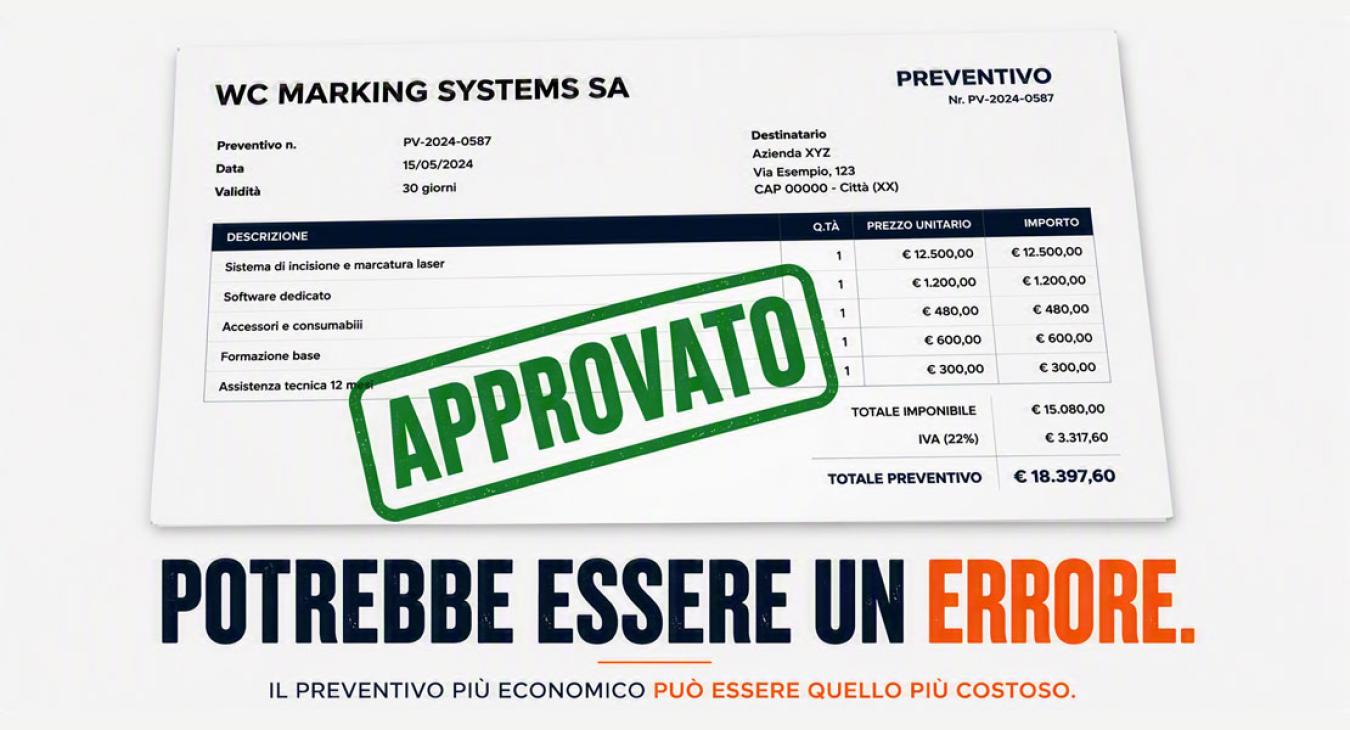
Most quotations compare machines. Few reveal what it actually takes to achieve the desired result.
When investing in a machine for personalization, engraving, or marking, price is probably the easiest factor to compare.
It is clearly stated in the quotation, it is immediate, and it seems to provide an objective basis for making a decision.
Let's imagine three offers.
One machine costs €12,000, a second costs €15,000, and a third costs €18,000.
At first glance, the choice seems obvious: the first one appears to be the most affordable.
But is it really?
The purchase price tells you how much you will spend to buy the machine.
It does not tell you how much it will cost to use it.
It does not tell you how much time each job will require, how many tests will be needed before achieving satisfactory results, how many mistakes will be made, or how dependent the final outcome will be on the operator's experience.
Most importantly, it does not tell you whether that machine is genuinely suited to the objective it was purchased for.
A jewelry store may purchase an affordable machine to engrave rings, bracelets, and pendants.
A few months later, it discovers that positioning certain items takes longer than expected, that some jobs are more complex than necessary, and that certain tasks still need to be outsourced.
An industrial company may compare marking systems based on power, speed, and price.
Later, it discovers that the quality of the markings on nameplates is inconsistent or that the system does not integrate properly into the production workflow.
A retail chain may choose the same technology for all its stores.
The machine works, but the workflow is too complex to be used consistently by different operators across multiple locations.
In all of these cases, the machine may be technically sound.
It may even work perfectly.
That does not automatically make it a good investment.
The real cost of an engraving, marking, or personalization technology is not limited to the number shown on the quotation.
An investment can be purchased wisely and still be used poorly.
A machine may be technically capable but unsuitable for the people expected to operate it.
It may work perfectly while requiring more time than expected, insufficient training, or procedures that are too complex for the environment in which it is deployed.
This is often where the most important part of the investment lies.
The real cost of a technology also includes:
None of these items typically appear on a quotation.
All of them, however, directly affect the profitability of the investment.
This is precisely how an apparently inexpensive machine can become the most expensive solution.
True savings do not come from purchasing technology at the lowest price.
They come from using that technology effectively, consistently, and profitably.
Choosing the least expensive solution is not necessarily a mistake.
Likewise, spending more does not automatically guarantee a better outcome.
There are expensive machines that are oversized for the actual needs of a business.
There are also affordable machines that perform their intended tasks perfectly.
The point is not whether you spend more or less.
The point is understanding which solution will deliver the desired result with the lowest overall cost.
To answer that question, the objective must first be clearly defined.
Do you need to personalize a few items per day or handle high production volumes?
Will the work be performed by a skilled operator or by multiple staff members across different locations?
Do you need to engrave a single material, or do you plan to expand your offering over time?
Does the marking need to be decorative, traceable, or integrated into an industrial process?
Are you replacing a manual operation, bringing a service in-house, or creating a new revenue stream?
These are the questions that determine the value of a solution.
Not the discount shown on the quotation.
At PCube, we often repeat a simple concept.
A machine, by itself, is just an object.
It gains value when it enables a company to do something it could not do before, or to do it better.
For a retailer, it may mean personalizing a product in front of the customer.
For a jewelry business, it may mean making engraving faster, more precise, and more repeatable.
For an industrial company, it may mean making marking more reliable, consistent, and integrated into the production process.
For a retail chain, it may mean replicating the same service across multiple locations while maintaining operational simplicity and consistent quality.
That capability is what should be compared.
Not just the machine.
There is no single answer that works for everyone.
A jewelry store, a craftsman, an industrial manufacturer, and a retail chain may all have completely different requirements, even when using apparently similar technologies.
For this reason, we believe that a good solution deserves a few questions before an answer.
Before discussing a machine, we prefer to understand:
Only then does it make sense to compare the available options.
Companies that already know the technology and understand exactly what they need can purchase directly through our eCommerce platform, with transparent public pricing.
Those who would like a more in-depth discussion can review applications, operational processes, and future objectives together with our consultants.
Technology comes afterwards.
First, it is necessary to understand which problem it is expected to solve.
Because a machine can be purchased in a matter of minutes.
Making the right choice requires a few more questions.